
Many small business owners rely heavily on Facebook.
You post updates, people engage, and maybe somebody sends a message.
But when somebody searches on Google for the service you offer or a question related to your business, those posts usually will not appear.
That is where blogging helps.
A blog gives Google more content to understand, index, and show in search results.
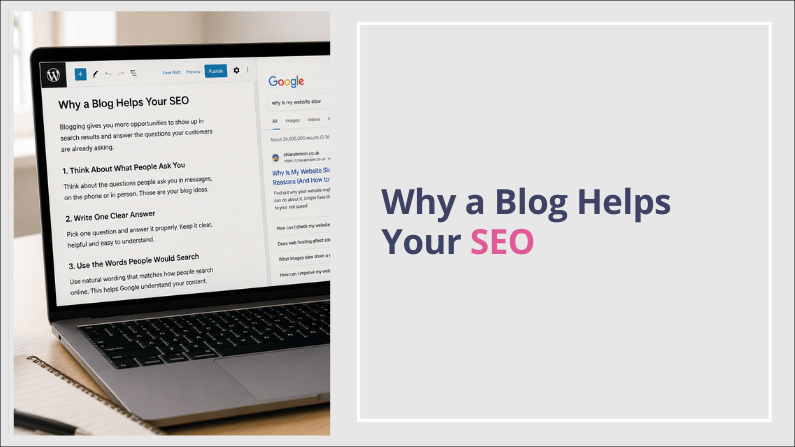
How to Use a Blog to Boost Your SEO
A lot of small businesses know they probably “should” have a blog.
Then they sit there staring at a blank page wondering what on earth they are supposed to write about.
Honestly, it is usually much simpler than people think.
Google needs content to work out what your business actually does.
Your main pages only cover so much.
A blog gives you room to answer the questions people are already asking you every week anyway.
Things like:
- “Why is my website slow?”
- “Do I need a new website?”
- “Why has my boiler pressure dropped?”
- “How often should I service this?”
Every useful answer is another chance for somebody to find your business online.
That is really all blogging for SEO is.
Start With Questions You Already Get Asked
This is the bit people overcomplicate.
You do not need some fancy content strategy to begin with.
Half your blog ideas are probably already sitting in:
- your inbox
- Facebook messages
- contact forms
- conversations with customers
If people keep asking the same thing, write about it.
Simple as that.
I actually had the idea recently of using Gmail’s AI assistant to scan emails for repeated questions because clients ask the same things over and over without realising it.
That is useful content.
Not because some SEO expert said so.
Because real people are already asking.
That is usually the best place to start.
Keep Each Post About One Thing
A lot of business owners try to cram everything they know into one blog post.
Usually it just turns into a mess.
One question. One answer.
That works much better.
For example:
- Why is my website slow?
- What happens if my domain expires?
- Do I really need SEO?
- Why is my site not showing on Google?
Pick one thing and explain it properly.
You do not need:
- huge word counts
- loads of jargon
- some perfect SEO formula
You just need to be useful.
Write Like You Speak
This matters more than people realise.
You can usually tell when somebody has written a blog trying to “sound professional”.
It ends up sounding stiff and strange.
Most people would rather read something clear and normal.
Short paragraphs help.
Simple explanations help.
Real examples help.
Trying too hard usually does not.
You Do Still Need To Help Google Understand The Topic
SEO still matters obviously.
If your blog post is about:
“Why is my website slow?”
then use that wording naturally in:
- the title
- a heading
- the opening paragraph
You do not need to repeat it 47 times like it is 2009.
Google is much better at understanding context now.
Clear beats clever most of the time.
Consistency Beats Perfection
This is where people disappear into a planning spiral.
They:
- buy courses
- make spreadsheets
- brainstorm 100 ideas
- post absolutely nothing
One useful blog post a month is better than endlessly preparing to start one.
Seriously.
Most websites do not need daily content.
They just need signs of life and useful information.
AI Can Help. But You Still Need A Brain Behind It
This is becoming a big issue now.
AI is useful for:
- planning ideas
- helping structure content
- speeding up rough drafts
I use it myself.
But some websites are now publishing endless AI-written blog posts that all sound vaguely polished but say absolutely nothing.
Google is getting better at spotting that.
So are humans.
You have probably read posts where:
- every sentence sounds “correct”
- everything feels polished
- but somehow it also feels empty
That is usually because there is no real experience behind it.
The best content still tends to include:
- actual examples
- opinions
- real customer situations
- practical advice
- human judgement
That stuff matters.
Do Not Forget To Link Back To Your Services
This sounds obvious but loads of people forget.
If somebody reads your blog and thinks:
“That was helpful”
they need somewhere to go next.
That might be:
- your contact page
- a related service
- a guide
- a website audit
For example, on my own site I naturally link blog posts back to things like:
Nothing aggressive.
Just make the next step easy.
Share The Post Properly
A lot of people publish a blog post and then never mention it again.
Which is a bit pointless really.
At minimum:
- share it on Facebook
- mention it when relevant
- reuse parts of it later
- send it to clients when they ask related questions
One decent blog post can save you loads of repeated explaining over time.
That is one of the underrated benefits.
Blogging Is Really Just A Collection Of Useful Answers
That is probably the easiest way to think about it.
You are not trying to become a full-time writer.
You are just answering useful questions in a place Google can find them.
Over time:
- your website grows
- your authority grows
- Google understands your business better
- more people discover you
It builds slowly.
But it does build.
Final Thoughts
You do not need perfect writing.
You do not need endless SEO tricks.
And you definitely do not need 300 AI-generated blog posts cluttering your website.
You just need:
- useful topics
- clear answers
- consistency
That is usually enough to put you ahead of a lot of small business websites already.
Want Help Planning Your Website Content?
If you are not sure what to write about, where to start, or whether your current content is helping your SEO at all, that is completely normal.
This is the kind of thing I help clients with regularly.
You can:
- explore my SEO copywriting services
- or start with a free website health check